IELTS Listening – Test 3
PART 1: Furniture Rental Companies
| Name of company | Additional notes |
|---|---|
| Peak Rentals |
– Prices range from $105 to $1(1) per room per month. – The furniture is very (2) – Delivers in 1-2 days – Special offer: free (3) with every living room set |
| (4) and Oliver |
– Mid-range prices – 12% monthly fee for (5) – Also offers a cleaning service |
| Larch Furniture |
– Offers cheapest prices for renting furniture and (6) items – Must have own (7) – Minimum contract length: six months |
| (8) Rentals |
– See the (9) for the most up-to-date prices – (10) are allowed within 7 days of delivery |
PART 2: Community Project & Dig Site
11. Who was responsible for starting the community project?
12. How was the gold coin found?
13. What led the archaeologists to believe there was an ancient village on this site?
14. What are the team still hoping to find?
15. What was found on the other side of the river to the castle?
16. What do the team plan to do after work ends this summer?
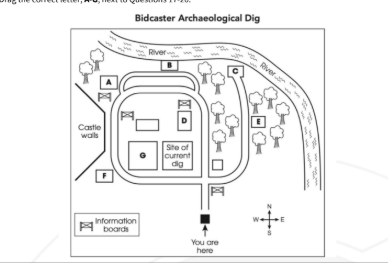
17. bridge foundations
18. rubbish pit
19. meeting hall
20. fish pond
PART 3: Theatre Programmes
21. Finn was pleased to discover that their topic
22. Maya says a mistaken belief about theatre programmes is that
23. Finn was surprised that, in early British theatre, programmes
24. Maya feels their project should include an explanation of why companies of actors
25. Finn and Maya both think that, compared to nineteenth-century programmes, those from the eighteenth century
26. Maya doesn’t fully understand why, in the twentieth century,
Choose FOUR answers from the box (A-F).
A. Its origin is somewhat controversial. | B. It is historically significant for a country. | C. It was effective at attracting audiences. | D. It is included in a recent project. | E. It contains insights into the show. | F. It resembles an artwork.
27. Ruy Blas:
28. Man of La Mancha:
29. The Tragedy of Jane Shore:
30. The Sailors’ Festival:
PART 4: Inclusive Design
Definition
– Designing products that can be accessed by a diverse range of people without the need for any (31)
– Not the same as universal design: that is design for everyone, including catering for people with (32) problems.
Examples of inclusive design
– (33) which are adjustable, avoiding back or neck problems.
– (34) in public toilets which are easier to use.
To assist the elderly:
– designers avoid using (35) in interfaces.
– people can make commands using a mouse, keyboard or their (36) .
Impact of non-inclusive designs
Access
– Loss of independence for disabled people.
Safety
– Seatbelts are especially problematic for (37) women.
– PPE jackets are often unsuitable because of the size of women’s (38) .
– PPE for female (39) officers dealing with emergencies is the worst.
Comfort in the workplace
– The (40) in offices is often too low for women.

Leave a Reply