IELTS Speaking Part 3
Experiential Learning
Evaluating Field Trips, Extracurricular Growth, and Holistic Student Development
Topic Vocabulary
Complement
/ˈkɒm.plɪ.ment/ (v)
To add to something in a way that enhances or improves it.
Extracurricular
/ˌek.strə.kəˈrɪk.jə.lər/ (adj)
Activities that are outside the regular course of study in a school.
Enrichment
/ɪnˈrɪtʃ.mənt/ (n)
The act of making something better or more productive.
Self-improvement
(n)
The process of making yourself a better or more skilled person.
Interpersonal skills
(n)
The skills used by a person to interact with others effectively.
Dropouts
/ˈdrɒp.aʊts/ (n)
Students who leave school or university before they have finished.
Classroom instruction
(n)
The traditional method of teaching through lectures and books.
Experiential knowledge
(n)
Information and skills gained through direct experience or activity.
*Click cards to hear pronunciation
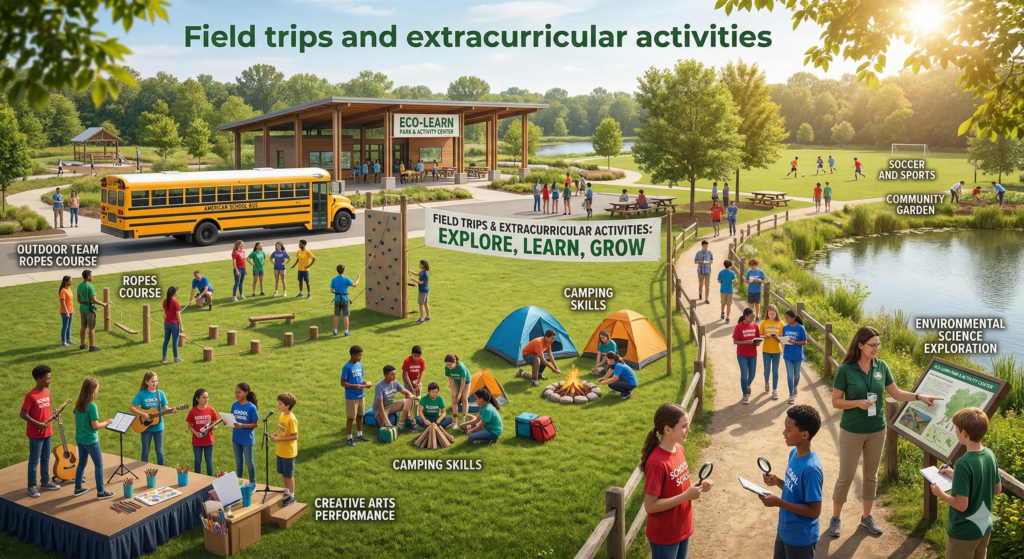
Role of Field Trips
- Provide opportunities to interact with peer groups.
- Complement the curriculum through outdoor learning.
- Are both educational and entertaining.
- Bridge the gap between theory and real-life experiences.
Extracurricular Benefits
- Encourage teamwork, creativity, and responsibility.
- Develop essential life and interpersonal skills.
- Promote self-improvement and interest exploration.
- Help prevent early school dropouts by building engagement.
Pedagogy Check-up
Question 1
How do extracurricular activities help prevent school dropouts?
Question 2
Knowledge gained from “field trips” is best described as:
Discussion Practice (Tự luận)
1. Role in Education
“What role do you think extracurricular activities play in education?”
Extracurricular activities play a pivotal role in providing a well-rounded education. While traditional classroom instruction focuses on academic knowledge, these activities nurture life skills such as teamwork and responsibility…
2. Eliminating Field Trips?
“Should field trips be eliminated and the time used for lesson-related activities?”
I strongly disagree with the elimination of field trips. These trips are not distractions; they complement the curriculum by providing outdoor learning opportunities that a textbook simply cannot provide…
3. Developing Social Skills
“In what ways do extracurricular activities develop social skills of school students?”
These activities provide a unique environment for interpersonal interaction. Unlike a quiet classroom, sports or drama clubs require active teamwork and communication. Students must learn to collaborate within a peer group…
4. Protecting Against Dropouts
“Do you think extracurricular activities protect against early school dropouts?”
Yes, they act as a protective barrier against school dropouts. For many students who struggle with academic subjects, after-school programs provide a reason to look forward to school. By strengthening interest areas…
5. Compulsory After-school Programs?
“Do you think after-school programs should be structured as a compulsory extension of learning?”
While the benefits are clear, I believe making them compulsory might be counterproductive. The beauty of these programs is that they allow for choice and voluntary self-improvement. If they become an obligatory extension of school, they might start to feel like a burden…
6. Personal Experience vs. Classroom
“Compare knowledge from personal experience with classroom instruction. Which is more effective?”
This is a comparison between theoretical and experiential knowledge. Classroom instruction provides the essential framework, which is vital for organized learning. However, personal experience is often more effective because it is irreversible and visceral…
7. Personality Development
“How can extracurricular activities promote personality development?”
Extracurriculars are essential for character building. They force students out of their comfort zones, requiring them to face challenges and develop resilience. Participating in a debate club or a sports team requires asserting oneself and taking calculated risks…
8. Contribution to the Learning Process
“How do school trips or enrichment activities contribute to the overall learning process?”
Enrichment activities act as a bridge between theoretical knowledge and practical application. They make the learning process more vibrant and engaging by allowing students to see the real-life experiences associated with their subjects…
Tri Duc English
© 2024 Educational Material – Topic 45: Field Trips & Extracurriculars
Leave a Reply