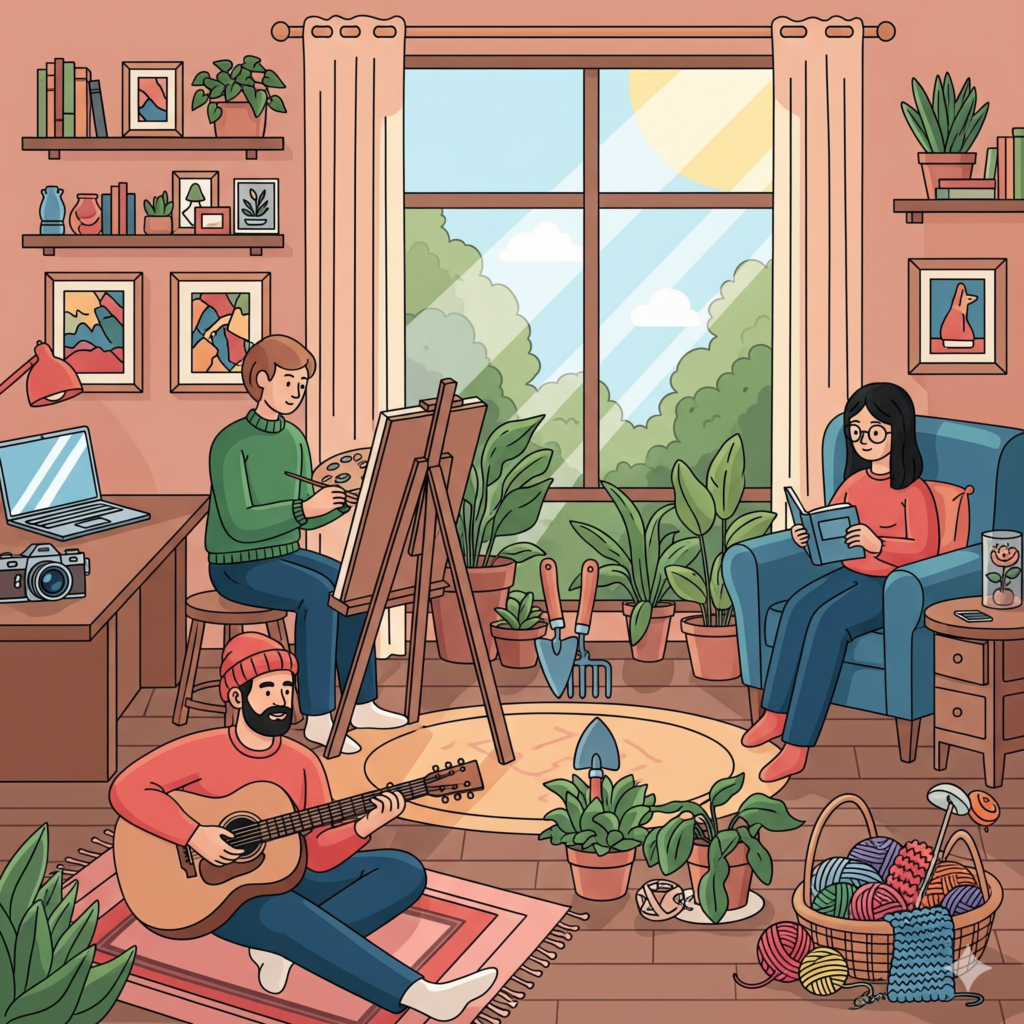
IELTS Speaking Part 3
Hobbies & Self-Development
Evaluating the Benefits of Productive Leisure, Social Interaction, and Life Balance
Từ vựng thiết yếu (Vocabulary)
Productive leisure
(n)
Free time spent on activities that provide personal growth or skill development.
Self-expression
/ˌself.ɪkˈspreʃ.ən/ (n)
The act of showing your feelings or personality through creative activities.
Accomplishment
/əˈkʌm.plɪʃ.mənt/ (n)
A feeling of pride when you finish something difficult or successful.
Discipline
/ˈdɪs.ə.plɪn/ (n)
The ability to control yourself and make yourself work hard or behave in a particular way.
Outdoor pursuits
(n)
Activities that are done outside, such as hiking, sailing, or gardening.
Relief from stress
(n)
A feeling of relaxation when something unpleasant stops or is removed.
Pastime
/ˈpɑːs.taɪm/ (n)
An activity that is done for enjoyment; a hobby.
Self-development
(n)
The process of learning new things and improving your skills.
*Click cards to hear pronunciation
Luyện tập Thảo luận (Full 16 Discussion Questions)
1. Necessity of Interests
“Do you think people need to have an interest or hobby?”
Absolutely. Hobbies are essential for mental hygiene. They provide necessary relief from stress and contribute to productive leisure time. Without an interest outside of work, life can become monotonous, whereas a hobby offers a sense of self-fulfillment and keeps the mind active and creative.
2. Healthiest Leisure Activities
“In your opinion, what are the healthiest leisure activities?”
The healthiest activities usually involve outdoor pursuits like hiking or swimming, which improve cardiovascular health. However, mental health is equally important; thus, activities like reading or meditating are also healthy as they foster relaxation and inner peace, balancing the physical and psychological self.
3. Workday Integration
“Should a leisure activity be incorporated in the working day?”
Yes, integrating short leisure periods into the workday can significantly boost productivity and morale. It helps workers manage tension and prevents burnout. Companies that offer recreational facilities often see an increase in employee creativity and a better organisational atmosphere.
4. Work-Leisure Balance
“How can we balance the amount of time we spend on work and leisure?”
Achieving balance requires discipline and time management. We must set rigid boundaries for working hours and intentionally schedule time for relaxation. Prioritizing quality time over “busy work” allows us to maintain our mental health and ensures that we have enough energy for both professional achievements and personal hobbies.
5. Outdoor Pursuits & Social Skills
“Do you share the opinion that outdoor pursuits encourage social skills?”
I do. Outdoor pursuits often involve group cooperation, whether it’s navigating a hiking trail or playing a team sport. These activities require interpersonal interaction and effective communication, which naturally build confidence and social empathy. They take us away from alienated digital screens and into real-world social environments.
6. Social Life Benefits
“In what ways are hobbies beneficial to social life? Give examples.”
Hobbies act as a “social glue.” For example, joining a book club or a photography group allows people to meet others who share their common interests. This facilitates cross-community dialogue and helps build new relationships. Hobbies provide a shared universal language of passion that can bridge cultural or age gaps, reducing feelings of loneliness.
7. Coping with Modern Life
“What ways do leisure activities help us cope with modern life?”
Modern life is characterized by hectic schedules and high urban stress. Leisure activities provide a much-needed “recharge” period. They allow us to disconnect from electronic technologies and reconnect with our own thoughts and feelings. By engaging in hobbies, we build the resilience needed to handle academic pressure or professional stress without losing our self-fulfillment.
8. Benefits of Collecting
“What educational benefits do you think collecting objects like coins or stamps might have?”
Collecting is an illuminating hobby. It enriches our understanding of history and global institutions. Through coins or stamps, one learns about different historic eras, geography, and cultural identity. It fosters analytical skills as the collector must research and categorize items based on established facts, making it a form of informal, self-paced education.
9. Changes Over the Years
“How has the way people spend their free time changed over the years?”
In the past, leisure was more community-oriented, involving family gatherings and folklore. Today, due to globalisation and technology, leisure has become more individualistic and screen-based. While we have more variety, we have lost some of the cultural cohesion of the past. There is now a greater emphasis on materialistic entertainment, such as shopping, rather than the simple pleasures of nature.
10. Future Pastimes (100 Years)
“What do you think pastimes and hobbies will be like in 100 years’ time?”
In a century, hobbies will likely be deeply integrated with artificial intelligence and virtual reality. We might engage in “simulated travel” as a primary pastime. However, as technology makes life more mechanical, I predict a strong movement back toward traditional handicrafts and gardening as people seek to nurture a connection with the physical world and combat digital alienation.
11. Influence of Fashion/Trends
“Do you think people’s hobbies and interests can be influenced by fashions and trends?”
Definitely. The world media and social influencers have a profound influence on what is considered “trendy.” For example, the recent surge in yoga or digital art is heavily driven by sales promotion and celebrity endorsement. While some pursue hobbies for genuine self-development, many others are drawn to them out of a desire for popularity or to fit into a specific subculture.
12. Family Entertainment
“In your opinion, what kinds of entertainment can a family enjoy as a whole?”
Families benefit most from activities that promote togetherness and nurture relationships. This includes playing board games, which develop problem-solving capabilities, or going on family holidays. Sharing a meal or watching an educational film can also provoke discussion and strengthen attachments, preventing the family from becoming disintegrated.
13. Regional & Climatic Variation
“How do recreational activities vary according to region and climate?”
Climate dictates the feasibility of different hobbies. In cold climatic conditions, people prefer indoor pastimes or winter sports like skiing. In tropical regions, outdoor pursuits like swimming or water sports are more common. Geography also plays a role; coastal regions focus on marine activities, while mountainous areas encourage hiking. Climate thus shapes the very character types and daily routines of different communities.
14. Hobbies & Self-Development
“Do you agree that hobbies contribute to self-development?”
I strongly agree. Hobbies are a laboratory for self-improvement. They teach discipline, as mastering a skill like playing an instrument requires thousands of hours of practice. They provide a sense of accomplishment and boost confidence. By allowing for self-expression and creativity, hobbies help individuals discover their identity and achieve self-fulfillment beyond their professional roles.
15. Negative Effects of Over-Indulgence
“What negative effects might spending too much time on a hobby have?”
When a hobby becomes an obsession, it can lead to social isolation and the neglect of family responsibilities. It may also interfere with one’s career or academic subjects, leading to failed expectations. Financially, some hobbies can become a heavy burden to the budget. The key is moderation; leisure should complement a productive life, not replace it.
16. Shopping as a Pastime
“Shopping has become a favourite pastime among young people. Discuss why?”
This is largely due to the rise of consumerism and materialistic attitudes in modern society. For many young people, shopping is a form of socialization and a way to project an image of success. The vibrancy of shopping malls and the suggestive nature of advertising make it an enticing, though often expensive, pastime that provides a temporary feeling of delight and status.
Tri Duc English
© 2024 Educational Material – Topic 55: Hobbies & Leisure (Full Set)
Leave a Reply