TRI DUC ENGLISH
Reading Practice: The Invention of Variable-Pitch Propellers
Until the late 1920s, airplane propellers were made of a single piece of wood attached at the center to the driveshaft of the engine. The tilt of the propeller, that is, how flatly it faced the wind, was fixed, which meant planes flew as if they had only one gear. If the plane had a fine propeller, it traveled the entire time as if in first gear, working well on takeoff and landing but working inefficiently during sustained flight. If the plane had a thick, coarse propeller, it traveled the entire time as if in high gear, working efficiently during sustained flight, but making takeoffs and landings dangerous and prolonged. This inflexibility meant that commercial uses of such aircraft were limited because the planes could not carry heavy loads either safely or efficiently.
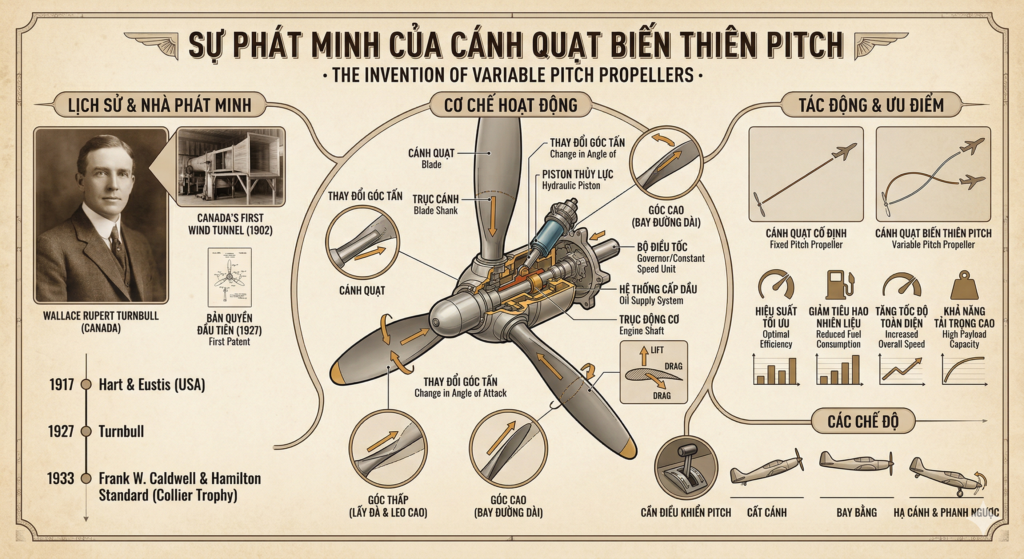
In 1922, Wallace Rupert Turnbull patented his latest invention, the Variable-Pitch propeller. His propeller in effect gave airplanes gears. The propeller’s blades were separate from each other, attached at the driveshaft in the center, and could be moved independently or together to chop the air at different angles. The propellers could be tilted at takeoff and landing to act as if in first gear, chopping less air with each rotation, and could be tilted when cruising to act as if in high gear, chopping more air with each rotation. With this Variable-Pitch propeller, planes could now take off and land more safely and reliably, carry varying weights, and handle greater variations in wind speed and turbulence.
Turnbull was born in New Brunswick in eastern Canada in 1876. He studied mechanical engineering at Cornell, then continued his post-graduate studies in Europe, and returned to work at the Edison labs in New Jersey. In 1902, just one year before the Wright brothers made their historic flight, Turnbull went back home, set up his own lab in a barn, and started running his own aviation experiments.
To begin, Turnbull needed a wind tunnel. He built a wind tunnel, the first in the world, out of packing materials. In it, he tested different designs for propellers and wings; his research is the basis for many of the successful designs still in use today. Alone in his barn, Turnbull designed and tested his Variable-Pitch propeller. It was tested successfully in flight in Borden, Ontario, on June 6, 1927.
Turnbull spent his life experimenting and designing for the new science of aviation in his barn in Rothesay. He sometimes conferred with fellow aviation enthusiast Alexander Graham Bell in Nova Scotia, but for the most part, he worked in isolation. Unlike most engineers, he chose not to work in a university laboratory or in a lab such as Edison’s, where he would have been supported by like-minded engineers and physicists. Instead, he spent his adult life in a barn he equipped himself. Depending only on his intelligence, curiosity, and work ethic, he revolutionized flight. He is honored in Canada as a pioneer in aviation and a genius in the study of aerodynamics.


Leave a Reply