TRI DUC ENGLISH
Reading Practice: The Development of the Lightbulb
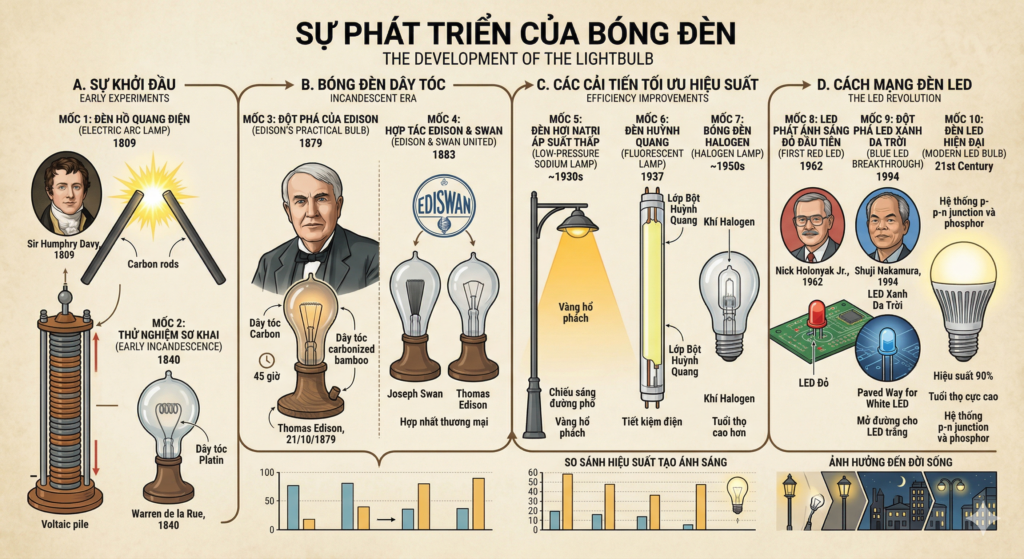
Thomas Edison is generally credited with the invention of the lightbulb. In fact, he was just one inventor among many involved in the process of moving the concept of incandescent light from inspiration to marketable reality. What he actually invented in 1879 was a carbon filament that lasted for forty hours. In 1880, he improved his idea, producing a filament derived from bamboo that burned for 1,200 hours.
The first person to successfully produce light with electricity was Humphry Davy, who connected a carbon filament to a battery in 1809. Other inventors worked on refinements of this idea. In 1835, James Lindsay unveiled an electric lamp, which cast enough light to read a book one and a half feet away. In 1854, Henrich Globel created the first actual lightbulb—a glass bulb containing a filament that glowed when electrical current passed through it. However, it burned out too quickly to have any commercial value. Then, Hermann Sprengel developed the Sprengel Pump, a device that used mercury to create a vacuum. Reducing the oxygen in the bulb allowed the filament to glow longer before burning out.
In 1874, Henry Woodward and Matthew Evans filed a patent for a light specifically described as “a shaped piece of carbon held between two electrodes enclosed in a glass vessel.” Woodward and Evans attempted to raise the necessary money to improve and market their invention; however, as entrepreneurs, they had little success finding anyone to back them financially. Eventually they sold the rights to their patents to Thomas Edison.
Edison had already been working on the same idea, but for him money was not a critical issue. He was no longer a solitary inventor working in his basement, but the head of a laboratory with the support of investors. He worked to refine the Woodward and Evans light because its filament burned out too quickly. Edison set about testing every material possible for use as a filament. “Before I got through,” Edison recalled, “I tested no fewer than 6,000 vegetable growths, and ransacked the world for the most suitable filament material.” He even considered using tungsten, which is the material currently used. Eventually, Edison tried a carbonized cotton thread filament clamped to platinum wires. When tested, it lasted forty hours. In 1880, he received a patent for this invention. By the end of the year, Edison had perfected a sixteen-watt bulb that lasted for 1,500 hours.
At the same time, Sir Joseph Swan was working on similar ideas in England. In 1860, he obtained a patent for a carbon filament incandescent lamp, and in 1878, another for an improved version of his lightbulb. He presented it in a public lecture in 1879. In 1882, Swan sued Edison for patent infringement. As part of the settlement, Edison had to take Swan as a partner in his British electric works. Also, in 1877 and 1878, William Edward Sawyer and Albon Man were granted patents for electric lamps. Based on these patents, the U.S. Patent Office ruled in 1883 that Edison’s patents were invalid. Edison fought to appeal that ruling, and in 1889, the court determined that his patents were indeed valid.
Edison is famous for having said, “Genius is one percent inspiration and ninety-nine percent perspiration.” It is an understandable statement coming from someone whose laboratory tested more than 6,000 filament possibilities. Nevertheless, one might also consider the adage “History is written by the winners.” Edison may not have been the actual inventor of the lightbulb, but he was the man who had the genius, the business sense, and the financial backing to invent the first one that was commercially viable.


Leave a Reply