TRI DUC ENGLISH
Reading Practice: The Transatlantic Cable
Laying the transatlantic cable was the culmination of the unflagging perseverance of one man leading like-minded men, of disparate technical and scientific advances, and of the need for faster communication. The first attempts at laying the cable in the 1850s, each of which cost an enormous amount of money, failed utterly. Yet as technology and science improved, and the need for faster communication increased, perseverance finally paid off.
The man who rallied support and raised money for the transatlantic cable venture was Cyrus Field, a New York businessman, who started the New York, Newfoundland, and London Telegraph Company in 1854. For the next twelve years, Field raised money and expectations in North America and England for repeated attempts at laying a cable, despite catastrophic cable breaks and a formal inquiry when the first cable stopped working within days.
The scientific and technological advances began with electricity, the study of which was attracting the greatest minds of the age. Samuel Morse invented a code that made it possible to send information over electric wires, and he made the first successful transmission in 1842. The next year, d’Alamelda, a Portuguese engineer, announced the use of gutta-percha, a rubberlike sap from the gutta tree, as an insulation for wires. Thus, two of the requisites for an underwater cable were met. In the next several years, telegraph cables were laid in Atlantic Canada, across the English Channel and around Europe, and across the United States.
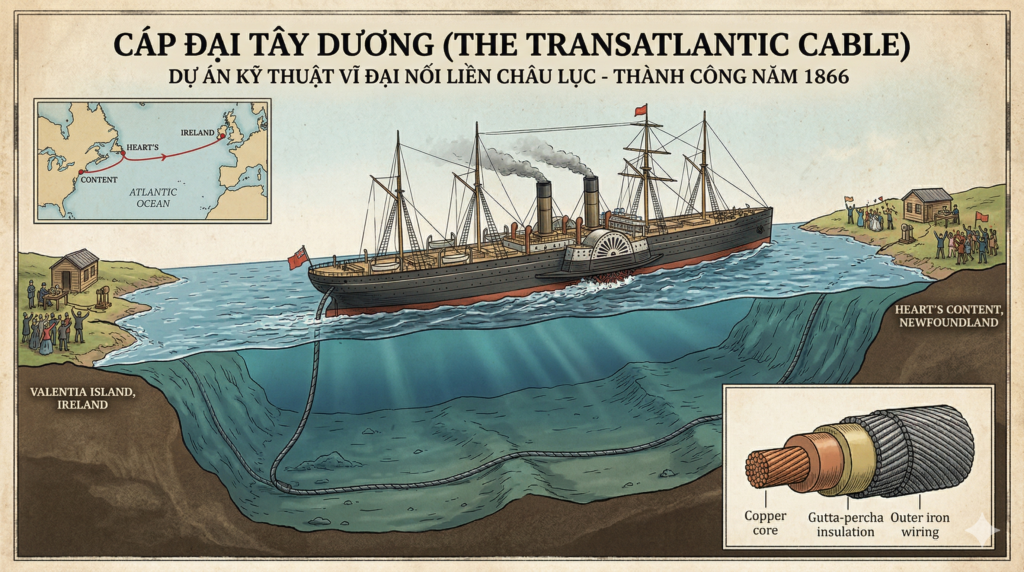
In 1857, the company Field founded set out to lay the cable that had taken months and almost a million dollars to make. The cable was made of 340,000 miles of copper and iron wire and three tons of gutta-percha insulation, too much for one ship to carry. The cable was divided between two ships, each towed by another, all four provided by the British and American navies. After only 255 miles of cable had been laid, the cable stopped transmitting and then snapped, sinking to the depths of the ocean. The second attempt was made in 1858, beginning at the midpoint of the Atlantic, from which each ship lay cable as she sailed to her home shores. Again, the cable inexplicably stopped working. They tried again a month later, beginning again from the middle and sailing in opposite directions. This time, successful Queen Victoria sent a message to President Buchanan, and both countries celebrated. Within hours, however, the signal began falling. To compensate for the fading transmissions, Whitehouse, the American engineer, transmitted messages at higher voltages, eventually burning out the cable. Once a hero, Field was now vilified.
Work on the transatlantic cable was halted because of the American Civil War. During the war, the telegraph became indispensable, and enthusiasm for a transatlantic cable mounted. In Scotland, William Thomson, who would later be knighted Lord Kelvin for his work, corrected the design flaws in Whitehouse’s cable. Kelvin also designed a mirror-galvanometer that could detect weak currents, thus allowing lower voltages and weaker currents to transmit information. In 1866, the world’s largest steamship laid Kelvin’s new cable, an unqualified success. Field’s perseverance had triumphed in the end.


Leave a Reply